Skip to content

Posts by losafrolatinos

From Loíza, Puerto Rico: A lovingly curated children’s book selection

By Kim Haas

I’m so pleased to present this guest post. It was thoughtfully written by one of our favorite librarians, Daniel Pizarro. Daniel is the consummate gentleman. Plus, he’s smart and cares deeply about Loíza and the library’s patrons.

I met Daniel three years ago at Loíza Public Library in Puerto Rico. Our meeting represented a wonderful culmination of a series of emails and an eventual conference call solidifying a sister library collaboration between Loíza library and the Jersey City Free Public Library; which is my local library.

So, Daniel is my go-to-guy when I’m in need of a little inspiration and great recommendations for Afro-Latino and Afro-centered children’s books.

Los Afro-Latinos is currently working on an Afro-Latino Children’s Book Supplement. Until every “ i is dotted and t is crossed” and we publish the collection, we thought we would share with you Daniel’s contribution to the Supplement. And September is a great month to post Daniel’s selections as we shepherd our children back to school for the new year. Read more

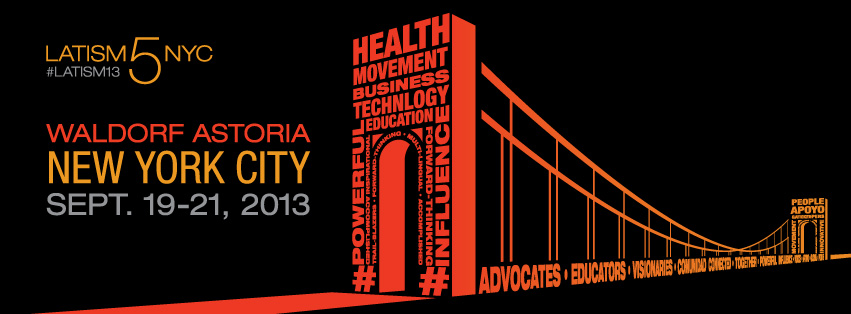
Los Afro-Latinos at LATISM 2013

LATISM 2013

We have very exciting news to share! Tomorrow (9/20), our founder, Kim Haas will be on the “Lets dare to talk about race in our Latino community” panel at this year’s Latinos In Social Media Conference in New York City. Along with Alicia Anabel, Dr. Georgina Falu, and Guesnerth Josue Perea, Kim will be discussing the following questions:

“Why is race such a taboo in our Latino community? Is there such a thing as racism among Latinos? Do we really really really treat each other equally? Are Afro-Latinos equally positioned in media or leadership? Let’s dare touch the core of the race issues with the help of experts in the field who are dedicating their lives to this issue.”

If you are in NYC and attending the conference, join the conversation from 10 – 11 a.m. in the Park Avenue Suite South. Even if you aren’t attending the conference, join in the conversation. Feel free to leave your thoughts on the above questions in the comments section below or join us on Facebook or Twitter.

Find out more info about the panel and conference.

Rosa Clemente: 1st Afro-Latina U.S. Vice Presidential Candidate Talks Politics and Purpose

by Nicolle Morales Kern

It may be three years until the next presidential election, but it’s never too early to explore politics and the people who focus on making a difference through our political system. For those of us who aren’t active in the day-to-day aspects of politics, from lobbying to campaigning, it can be hard to understand how much dedication politics requires. To get an idea of what politics is like behind the scenes, we interviewed Rosa Clemente, the first Afro-Latina Green Party Vice Presidential Candidate. During this interview, Rosa discusses her identity as an Afro-Latina, her experience during the 2008 election campaign, and the importance of political engagement.

Rosa Clemente is a community organizer, journalist, Hip Hop and political activist.  Five years ago, as the Vice Presidential Candidate for the Green Party, she and Cynthia McKinney, Green Party Presidential Candidate, formed the first women of color ticket.

The daughter of a mother from Ponce, and a father from Rio Pierdas, Rosa Clemente was born and raised in the Bronx. She earned her undergraduate degree at the University of Albany and her Masters of Professional Studies at Cornell University. She is currently in her second year of a doctoral program at the University of Massachusetts Amherst, and her dissertation focuses on the Black Latino, Hip Hop culture. Read more

Secret Stash Records’ Quest for Afro-Peruvian Music

by Kim Haas 

Cory Wong and Eric Foss are long-time friends and fellow musicians from small town Fridley, Minnesota. They first met when they were six years old. Cory plays the guitar and Eric enjoys drums and percussion. Growing up, the duo’s musical tastes would not suggest an eventual interest in Afro-Peruvian music. Eric recalled, “We grew up (listening to)….whatever you’d expect white kids from Minnesota to listen to…Metallica, Rage Against The Machine and other hard rock bands.” 

As adults, the two friends formed the Secret Stash Record Label in 2009, releasing funk, jazz, and world music. To some degree, Secret Stash, was formed out of  the many frustrations Eric experienced, working at several large record labels, “….I found myself disgusted with the industry; the way (large) retailers and distributors …. treat artists. ….walk into a retail store and you see a new album advertised (taking up lots of space)…like a whole wall (of the store).  The retailer did not put it there because they love the artist.  It is there because the distributor paid the retailer hundreds of thousands of dollars… It’s called Co-Op Advertising.”

Not only does Secret Stash approach the business of music differently but its sounds and recordings are decidedly unique for the 21st century. Nearly all of Secret Stash’s releases are on vinyl (accompanied by mp3s). Cory said, vinyl records offered the most accurate, recreated sound compared to CDs and other musical recording formats. The two music aficionados are focused and selective about tracks released under their label. “We …operate outside normal record business (models). Anything we put out, (we) are in love with it… I always feel that Secret Stash… offers a service. We are a filter……We can’t let things sift through that filter that don’t fit the criteria…” 

Now that the days of working for large labels and distributors is over for Eric, he finds great satisfaction in Secret Stash’s business model. He described their approach to collaborating with other businesses as an important aspect of the company’s brand, “In Minneapolis, Tree House Records and Electric Fetus will play your record because it’s about loving music (not) how to squeeze money out of labels.” Read more

1st Annual Afro Latino Festival of New York: Bringing People Together

by Kim Haas

Seeking to unite the diverse Afro-Latino populations, Tania Molina, a proud Garifuna, reached out to her friend Mai-Elka Prado, an Afro-Panamanian. Together, the two Afro-Latinas created the 1st Afro-Latino Festival of New York held Saturday, June 29 at Brooklyn’s Parkside Train Station Plaza.

In the United States, there are an estimated four million Afro-Latinos – the great majority of whom reside in the New York City area. From countries as different as Andean Peru and tropical Cuba, to the Garifuna population of Central America and to the innumerable descendents of Afro-Latinos who may have never set foot in their parents or grandparents homeland, this mega city of eight million is home to Latin America’s African Diaspora. 

Despite the diversity of Afro-Latinos in New York City, when there are gatherings and events, the focus is often on one particular group, nationality or concern like an Afro-Puerto Rican Bomba Performance or an Afro Colombian Land Rights Symposium. Rarely are there events focusing on Afro-Latinos as an entire group. Read more

An Afternoon with Dahlma Llanos-Figueroa [Event]

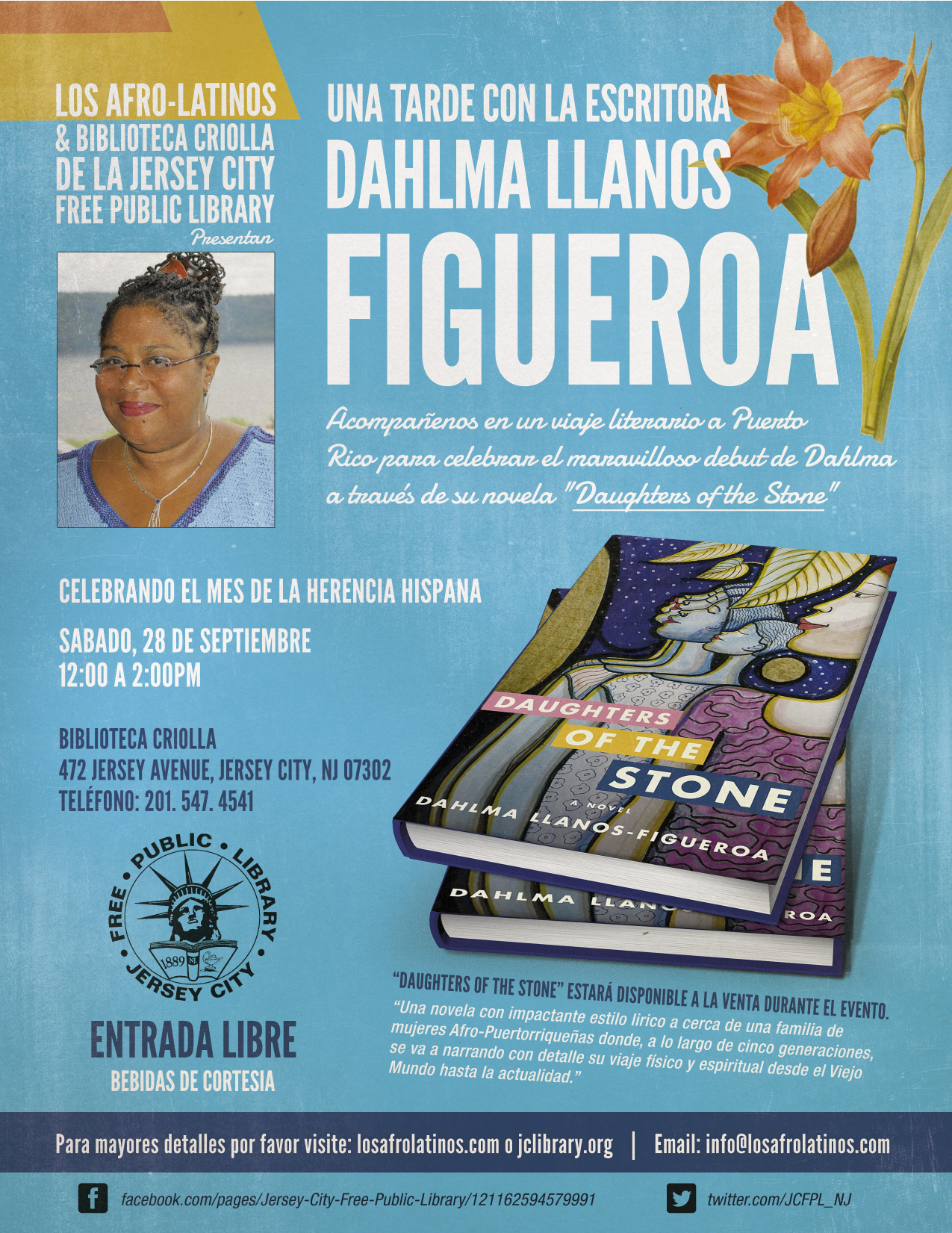
We are pleased to announce that our event with Dahlma Llanos-Figueroa has been rescheduled and will now take place on Saturday, September 28 from 12 – 2 p.m., and will be hosted at the Jersey City Free Public Library.

Los Afro-Latinos and Biblioteca Criolla of the Jersey City Free Public Library present: An Afternoon with Dahlma Llanos-Figueroa.

Join us on a literary journey as we celebrate Dahlma’s debut novel Daughters of the Stone.

Dahlma Llanos-Figueroa is an Afro-Puerto Rican and wrote Daughters of the Stone to share the rich legacy of African cultures in Puerto Rico. Read more about Dahlma and her motivation to write this novel here http://bit.ly/WSqzDs.

This event is FREE and open to the public. Refreshments will be served.

Date: Saturday, September 28, 2013
Time: 12 – 2 p.m.
Location: Jersey CityFree Public Library
Biblioteca Criolla
472 Jersey Ave.
Jersey City, NJ 07302

Dahlma Flyer English

Dahlma Spanish Flyer

Save the Date: An Afternoon with Dahlma Llanos Figueroa

Photo courtesy of Llanos-Figueroa

Photo courtesy of Llanos-Figueroa

Los Afro-Latinos Presents:
An Afternoon with Dahlma Llanos Figueroa, author of Daughters of the Stone

Date: Saturday, September 28 2013

Time: 12 – 2 p.m.

Location: Jersey CityFree Public Library
Biblioteca Criolla
472 Jersey Ave.
Jersey City, NJ 07302

Admission: FREE

Read more

Director Carlos Diegues: Bringing Brazil’s Black Culture to the Silver Screen

By Kim Haas

So much of Brazil’s dazzling culture, its personality, traditions and tenor, have roots steeped in the country’s African heritage. Brazil has been greatly endowed with a culture that shines due in large part to the nearly four million enslaved Africans brought to the country, beginning around 1500–until slavery officially ending in Brazil in 1888.

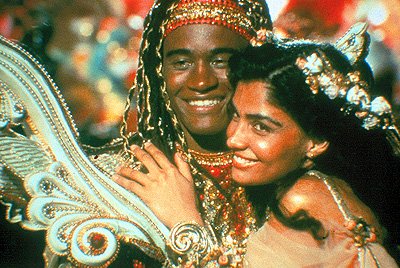
Samba originated among the country’s Afro-Brazilian population. Pele revolutionized soccer. Capoeira continues to amaze with its athleticism, power and grace and no other country comes close to putting on an annual party as spectacular as Carnival. Orfeu Movie Photo
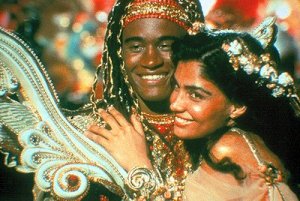
Despite these remarkable contributions to the soul of a nation, seeing Afro-Brazilians on the silver screen was a rarity until Brazilian Director Carlos Diegues began his filmmaking career in 1959. Mr. Diegues’ reputation was advanced because he was one of the filmmakers of Cinema Novo, a 1960s and 1970s Latin American film movement. Using a documentary filmmaking style, Cinema Nova promoted human rights, specifically advocating social justice and racial equality.
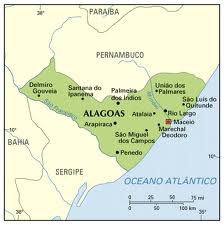
Alagoas

Alagoas, Brazil

Originally from Alagoas (northeastern Brazil), Diegues grew up completely infatuated by cinema. As a child he loved going to the movies. He was mesmerized by films. As he told a Cannes Festival Website, “The first time I went to the cinema, I was six. I looked at the screen, and I was totally hooked. In fact I was simply astonished and I thought, “Don’t touch the screen or you’ll get stuck. But I’m still stuck!”

During his early childhood, Carlos Diegues learned about the value and significance of Afro-Brazilian culture through fantastical stories.

His Afro-Brazilian nanny vividly narrated for him the story of Zumbi (The last leader of the Quilombo do Palmares located near Pernambuco, Brazil. Quilombos were settlements of escaped slaves in Brazil.) Diegues remembers, “She used to tell me that he (Zumbi) was still alive and could fly.” From childhood, Carlos Diegues strongly believed history and mythology could go together. As a filmmaker, he often fuses the two.

And as the son of an anthropologist, his father “…always told me that the African influence in Brazilian culture was very important.” Mr. Diegues adds, “Undoubtedly I’ve always been interested in Afro Brazilian culture but I think that even if the Afro descendent people were the social, poor people in Brazil, they were very strong in terms of the culture. African people were slaves until 19th century and they became the poorest people in the country but at the same time their culture represents the Brazilian culture…you know the Samba, soccer, the carnival. I was very much interested, intrigued by the fact that those people who suffered so much, that had a lot of pain during centuries, they made a culture that was stronger, stronger than the European culture in Brazil.”
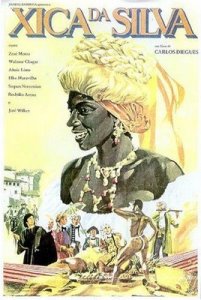
Xicade Silva Poster

In a career spanning five decades, Mr. Diegues was honored with a film retrospective at The Film Society of Lincoln Center in New York City from April 12 – April 18, 2013. This groundbreaking director is credited with being one of the first Brazilian filmmakers to tell the stories of the Afro-Brazilian experience on the silver screen.

Perhaps one of his most celebrated films is the 1976 “Xica da Silva,” the screen adaptation of the João Felicio dos Santos book, Memórias do Distrito de Diamantina. The story centers around the real life of Xica da Silva, a former 18th century slave from Minas Gerais, Brazil who becomes the wealthy mistress of Portuguese mine owner in Brazil, João Fernandes de Oliveira. Mr. Diegues shares his experience in the filmmaking process, “I didn’t know particular things about her, so I could mix myth and history about her.” After the film’s release, it would become Brazil’s 1977 entry for the Academy Award in Best Foreign Language Film but the process of making and distributing the film was very challenging.

He was told by a film distributor, “Black people doesn’t make money in the cinema.”  In response Diegues explains, “I felt like this wasn’t true, the process was very difficult. I had a producer who understood what I wanted to make, people always saying that ZeZe Mota (Xica da Silva actress) couldn’t make it. I always make things that people say can’t work… I was absolutely sure that I had to make this film. I gotta make this. I made it with a very happy kind of spirit. I thought that we needed this kind of film, someone who was a slave and became sort of a queen, but only by her virtues. It was something I was fascinated by.”
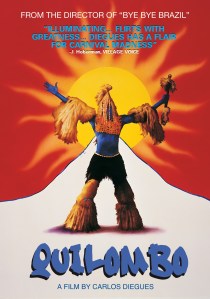
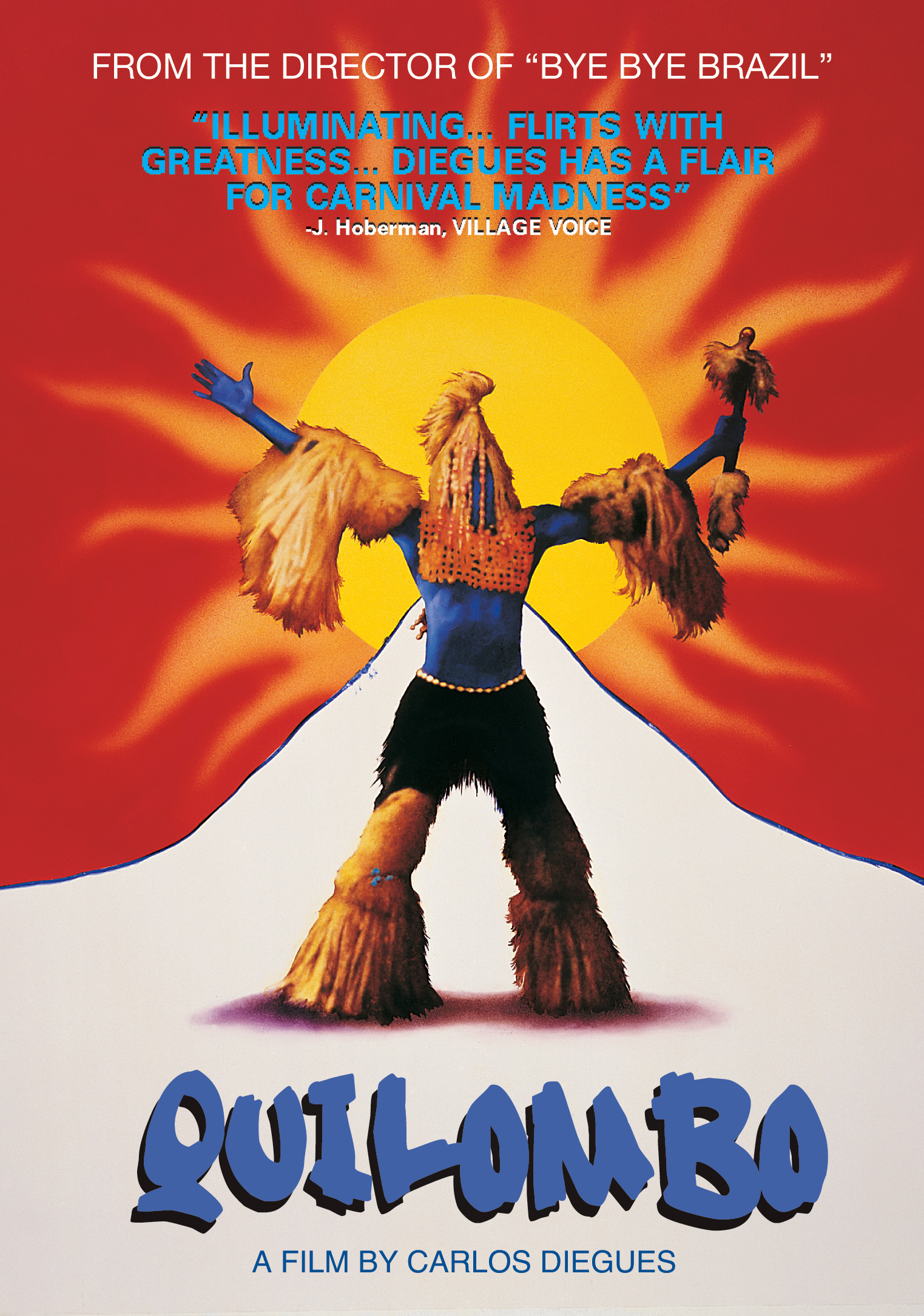
QuilomboEight years after the release of Xica da Silva, Mr. Diegues directed the 1984 film Quilombo, the story of Brazilian slaves who fled a sugar plantation to settle in the Quilombo dos Palmares in Northeastern Brazil. The film recounts the tale of the real life Quilombo dos Palmares, a structurally complex community of mostly former slaves which also welcomed Jews, Muslims, Indians and poor whites. At its pinnacle, the Quilombo dos Palmares had a population of 10,000 – 20,000 residents. It existed for nearly 100 years from 1600 – 1694. Led by it’s last leader Zumbi, a fearless soldier and exceptional military strategist, he led the Quilombo in a battle against the Portuguese for control of the settlement. In preparation for the film, Diegues says, “I was helped by a lot of professors and teachers, specialists in that kind of history. I tried to be very, very close to reality. For Quilombo we had many documents. Quilombo is not only a film about the past but also about future, it’s a utopia, what Brazil could be if we had a Zumbi today.”

Orfeu, Carlos Diegues 1999 production, is based on the book Orfeu da Conceição and also inspired by the 1959 Brazilian film Black Orpheus; both based on the legendary Greek tragedy of Orpheus and Eurydice. Diegues’ version is set in Rio de Janeiro during Carnival.

Carlos Diegues’ work behind the camera as a director has created numerous roles for Afro-Brazilian actors in front of the camera.

When asked the state of opportunities for Afro-Brazilians in film and television, Mr. Diegues says things are changing. “It’s getting better. Brazilian cinema has a role in the progress of it. (Brazilian TV) finally understood that Afro-Brazilians could be good actors, not just the maids and butlers. It’s changed, really changed.”

As a young filmmaker, Carlos Diegues and the filmmakers of his generation had an expansive vision for moviemaking. We wanted to “change the history of cinema, change the history of Brazil, change the history of the planet.”

Carlos Diegues is a change maker whose imprint on film is helping to tell the Afro-Brazilian story.

This slideshow requires JavaScript.

One-On-One with Afro-Rican Jazz Creator William Cepeda

Our April article for Being Latino features a Q&A with Afro-Rican Jazz Creator William Cepeda. This article was originally published on the Being Latino site

Since 1992, William Cepeda has been bringing Afro-Rican Jazz to the world. The music he shares with us is a combination of world music, progressive jazz, and traditional Afro-Puerto Rican roots and folk music and dance.

A Grammy-nominated artist and composer, and the protégé of John Birks “Dizzy” Gillespsie, William continuously advocates for research and documentation of Puerto Rico’s musical, dance, and cultural history. This dedication has won him numerous awards, grants, and recognition around the world, but is also a part of his family history. The Cepeda family was recently featured on an episode of CNN’s Inside Africa about Bomba dance.

Born and raised in Loiza, known as the heart of little Africa in Puerto Rico, he was always surrounded by music and dance. His love of music led him to seek formal education at the Berklee College of Music in Boston, the Conservatory of Music in Puerto Rico, and the Aaron Copland School of Music at Queens College. He holds two Bachelor of Arts degrees (one in jazz composition and arranging and one in music education) and a master’s degree in jazz performance.

In 1997, William created his own record label, Casabe Records.

I recently had the pleasure of interviewing him about his interest in music, why he decided to create his own label, and his latest project La Música de Puerto Rico: Raíces y Evolucíon (Races and Evolution). Read more

Afro-Uruguay: Forward Together

Our March article for Being Latino focuses on Afro-Uruguay: Forward Together, a documentary film dedicated to capturing the Afro-Uruguayan experience.

Through the lens of the video camera, two U.S. filmmakers immerse themselves and their family in Uruguay, capturing history as a small country tackles a big issue.

I have a deep fascination and profound interest in Afro-Uruguayan culture. Perhaps, this desire to know more is because I know so little about the country many call South America’s best kept secret – Uruguay.

Through pure serendipity, I stumbled across a beautifully written blog entry, “Uruguay, Mon Amor” by Carolina de Robertis. As a Californian of white Uruguayan parents, Carolina expressed her sorrow about the recent beating of an Afro-Uruguayan activist Tania Ramirez by a white Uruguayan. The violent exchange has sparked a national discussion in Uruguay regarding race.

Carolina, author of two critically acclaimed books and her spouse, African American filmmaker Pamela Harris, have relocated their family to Montevideo, Uruguay. The couple is dedicating 2013 to chronicling through the film the wide-ranging Afro-Uruguayan experience. The genesis of the film, Afro-Uruguay: Forward Together was sparked by the California couple’s 2004 honeymoon to Uruguay and an introduction to Candombe during a Llamada (The Call). Candombe is a musical experience originating from the Bantu people of Africa who were enslaved in Uruguay. Percussionists play three large curved, barrel shape drums (repique, chico and piano).

During a Llamada, percussionists, artists, dancers and people from the community drum rhythmically moving from one neighborhood to another, responding to “The Call.”


Read more