Skip to content

Posts by losafrolatinos

Pelé: Why Soccer Matters, Part 1

by Kim Haas

We are hours away from the beginning of the 2014 FIFA World Cup. With 32 nations participating, the World Cup is the most popular sporting event on the planet.  World Cup attendance is expected to reach 3.7 million people with an estimated 3.6 billion viewers.  Held every four years, Brazil plays host to this year’s games in 12 cities across the nation including: São Paulo, Salvador and Rio de Janeiro.
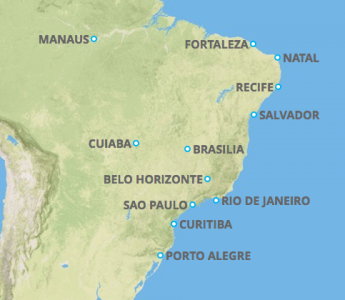
Brazil Host Cities

Brazil Host Cities

Connecting to the big game, los afro-latinos presents information about the game’s most popular and prolific player – Pelé (Edson Arantes do Nascimento).  Pelé began playing professional soccer at the age of 15 and joined the Brazilian national soccer team a year later. He’s an Afro-Brazilian who grew up in economic poverty in Bauru, Brazil.

His career spanned 2 decades. During that time, he won three FIFA World Cups, 1958, 1962 and 1970 and is the only player with that distinction. Pele’s honors are too many to cite here.  Two of them are: (1) he was declared a National Treasure by Brazil and (2) he was designated the best FIFA scorer, scoring 1281 goals in 1363 games.  Rumor has it that during the 1960’s 2 warring Nigerian factions agreed to a cease fire so they could watch Pele play in Lagos.

Pelé was magic in the air, flying vertically and horizontally, dazzling fans with his athleticism, quick thinking, field vision, power and passion for the game.  He’s credited with coining the term “o jogo bonito” (the beautiful game) when referring to soccer.

In this 2 part series, los afro-latinos spoke with writer Brian Winter, co-author with Pelé of the recently published book, “Pelé,“Why Soccer Matters.” Our conversation explores Pelé’s deep admiration for his father, his love for soccer and Pelé’s position as a global icon and role model.
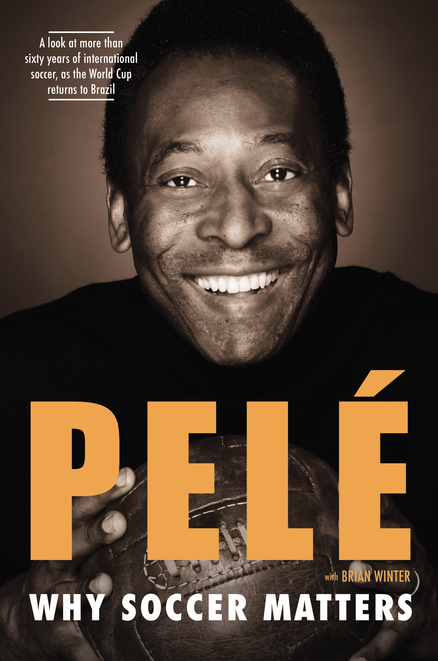
Pelé: Why Soccer Matters

Pelé: Why Soccer Matters


LAL: There are lots of media reports here in the United States about Brazil not being ready for this year’s World Cup. You’re in Brazil. Please share your thoughts. Is Brazil ready?

BW: Well they’re not ready. The stadiums, it appears, are going to be mostly done. I mean mostly. If you took all 12 stadiums and assigned a percentage it looks like we’re going to be 97, 98%. That’s just a guess. The important work (stadiums built) is done. Areas around the stadiums look like construction sites; not only in São Paulo but in Cuiabá, Curitiba, Natal and some of the other cities. I was at the São Paulo stadium yesterday before the last test match, before things opened up, and there were still missing chairs and the first game is in 10 days. As far as the various festivities, I suspect fans will be able to get in and see the game.

LAL: You’ve been in São Paulo, Brazil for a little more than 4 years. Brazil had 7 years to prepare for the World Cup. What are some of the reasons Brazil is not 100% ready?

BW: Part of the problem is what Brazil promised FIFA, the world and most importantly its own citizens, it would do, 7 years ago, when it first won the right to host this tournament. They (government) talked about using the World Cup as an opportunity to do a broad overhaul of dilapidated infrastructures. That was a general promise and then as recently as 2010 the government outlined all these building projects and airport improvements and other things. Some of those projects are going great but about half of them will not get finished in time for the Cup. So that’s a pretty high percentage of failing to deliver.

Brazil is not a country that has historically done big planning. It’s a country that relied on throwing a bunch of people at a problem, when it can’t quite finish the logistical planning and construction aspects. This is a problem in construction in general. And not just in sporting events. This was the case at the stadium I entered yesterday where there were all these issues with unfinished construction. And, there were literally hundreds of people, police, FIFA volunteers, other sort of groups set up by the local government standing around waiting to help. That’s historically the way things are kind of handled here and it looks like it’s probably going be the case with this event as well.

LAL: Where does Pelé stand in terms of how money is being spent for the World Cup?

BW: I can sort of describe what he’s said publicly. He’s been very critical (of the amount of money spent). And he was critical long before it was fashionable to be so here. Back in early 2011 he warned publicly that Brazil ran a risk of embarrassing itself during the Cup because of all these logistical problems. And at the time people kind of rolled their eyes at him and said, oh come on everything’s going to get sorted out. And here we are on the eve of the Cup and it’s not sorted out. It’s obvious that Brazil’s preparations are going to fall significantly short of what they were supposed to be.

LAL: For months, thousands of Brazilians have protested the government’s over spending on the World Cup and lack of investment in public services and infrastructure. Pelé has asked Brazilians not to protest during the Cup. Do you think that’s going to happen?

BW: No. The issues are too serious. There are groups of people (and labor unions) that are determined to go out and try to wreck this tournament. If that’s the mission, I don’t think they’ll succeed but they will disrupt. I have no doubt about that.

LAL: Have the police force and other security groups been trained to effectively deal with protest?

BW: I guess they have been trained. By Latin American standards certain police forces in Brazil can be quite disciplined. I mean that in a good way as a compliment to the police—but the spotlight here is going to be awfully bright and there’s going to be a lot of quite disturbing protesters. For that reason I fear that at least a few games are going to get pretty ugly.

LAL: Where will you be on June 12th ?

BW: I’m going to go as a civilian to at least one game and apart from that I’m going to be covering it as a reporter. And on the 12th I’m sure I’ll be in the writer’s office watching not so much the game, unfortunately to my distress as a soccer fan. I’ll be watching more from a news perspective looking at the protests and some of the things that are going on beyond the white lines (soccer field).

LAL: Do you have any predictions on what to expect during the games?

BW: I think there will be some significant logistical problems and the protests are going to get pretty ugly. I think most visiting fans will have a good time.
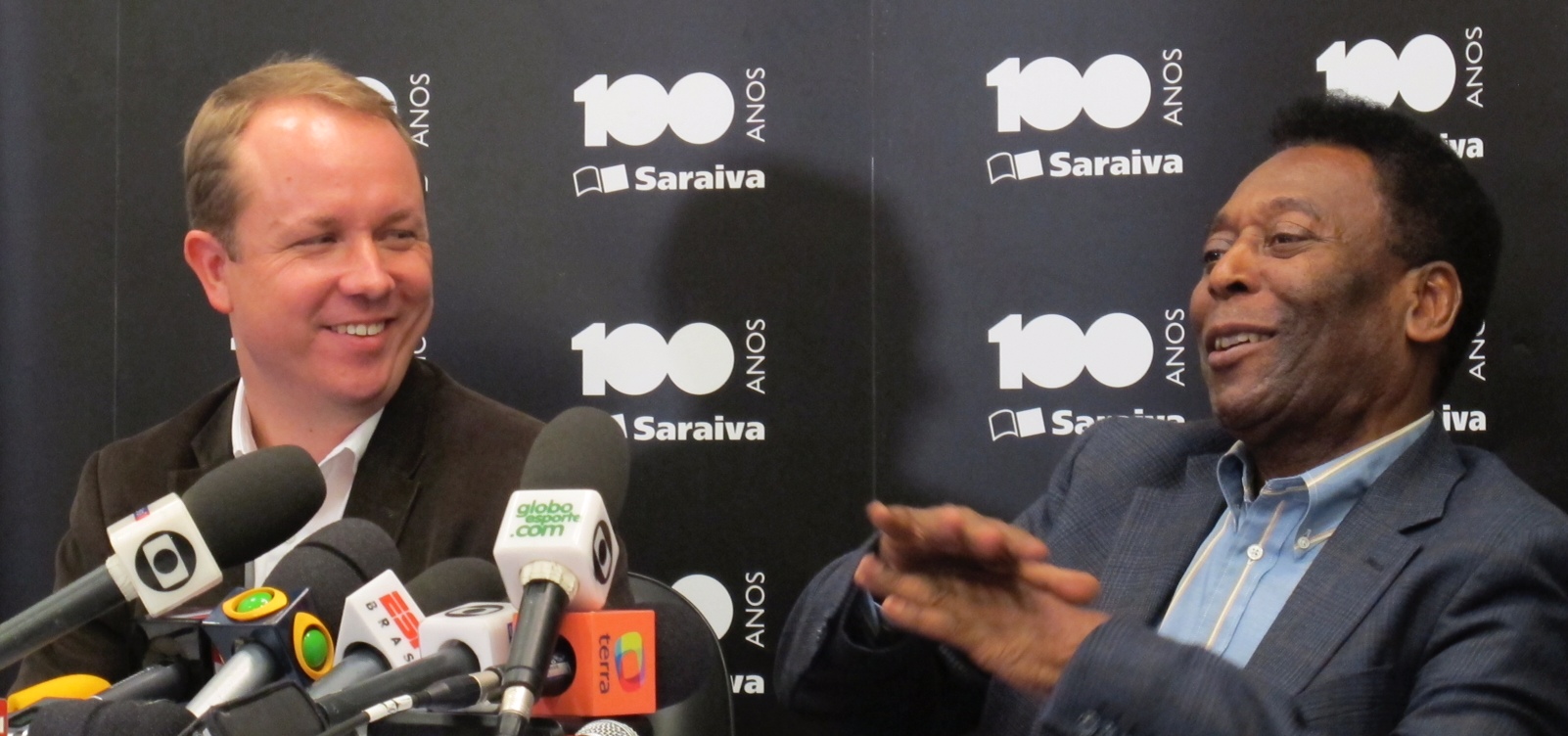
Pelé interview

Pelé and Brian Winter

Jacmel, Haiti’s Unshakable Carnaval

Several months ago, I announced that Los-Afrolatinos would “expand the tent” and cover not just Afro-Latinos but the larger African Diaspora as often as possible. Our current post focuses on Haiti; a country that captivates me. I’m inspired by its past, the first black republic in modern history, the resiliency, creativity and ingenuity of its people and its profound culture. With this post, I wanted to bring you another perspective of the island nation, beyond the doom and gloom so often reported. But rather, a look at how Haitians, despite seemingly endless challenges make room to create, celebrate and honor. I’m consistently inspired by how much Haitians accomplish despite a history which has been less than favorable. We can all gain strength by their sheer determination to persevere.

Jacmel’s 2014 Carnaval was covered for Los-Afrolatinos by freelance reporter, Amy Bracken. You can hear Amy’s work on Public Radio International, “The World,”  one of my favorite radio programs because of its’ in depth coverage of global issues, particularly those relating to Africa and Latin America.

Although we are publishing this post in May, Amy was in Jacmel in March for the town’s carnaval festivities. While this post is a bit behind schedule, I believe it’s right on time.

Enjoy Jacmel’s Carnaval!

Kim Haas, Founder


Read more

Dulce de Leche Brownie Recipe

Last week, we introduced you to Chef Leticia Moreinos Schwartz, in our post, The Best of Latin Baking. If after seeing the post, you were craving for one of those sweet treats, we have just the cure for you. Chef Leticia provided us with the scrumptious Dulce De Leche Brownie recipe, originally created by Pastry Chef David Lebowitz.  Enjoy!

Dulce de Leche Brownies

Yield: Serves 12

Ingredients
8 Tablespoons (120g) unsalted butter, cut into pieces, plus more for the pan
6 ounces (170g)  bittersweet chocolate
1/4 cup (30g) unsweetened cocoa powder
3 large eggs, at room temperature
1 cup (120g) sugar
1 teaspoon vanilla extract
1 cup (140g) flour
1 cup (250ml) dulce de leche

Pre-heat the oven to 350F. Grease an 8-inch square pan and line the bottom with parchment paper.

1. Melt the butter in a saucepan. Add the chocolate and stir constantly over low heat until melted. Remove from heat and whisk in the cocoa powder until smooth. Read more

Chef Leticia Moreinos Schwartz: The Best of Latin Baking

by Kim Haas

Recently, I interviewed Chef Leticia Moreinos Schwartz, author of The Brazil Kitchen and My Rio de Janeiro: A Cookbook at the Institute of Culinary Education (ICE) in New York City.  The interview focused on the cuisine of her native Brazil and its African culinary influences. Coming soon, we’ll bring you our interview with Chef Leticia, her photos from Salvador da Bahia, Brazil (the center of the country’s African roots) and a recipe or two.
Until then, I share with you photos from “The Best of Latin Baking.” Chef Leticia invited me to observe this class which she was teaching immediately after our interview.

Originally, I had only anticipated staying a few minutes. Instead, minutes turned into hours and a blog post developed. It was delightful to witness the commitment, precision and dedication of the 9 baking students.  They whirled around ICE’s kitchen like busy bees with tremendous focus and concentration. They beat, mixed, rolled and sifted ingredients, creating a mélange of Latin American desserts including:

  • Flan
  • Rocambole de Doce de Leite com Coco (Dulce De Leche and Coconut Roulade or Jelly Roll)
  • Nha Benta (Brazilian Mallomars)
  • Pão de Mel (Honey Cake)
  • Cheesecake de Coco com Calda de Goiaba (Coconut Cheesecake with Guava Sauce)
  • Brazilian Thumbprint Cookies (Topped with Powdered Sugar)
  • Quadrodos de Doce de Leite com Chocolate (Dulce de Leche Brownies)

Sharing these delicious desserts would not have been possible without the cooperation of the students. I sincerely appreciated their willingness to be photographed especially since this was not a planned blog post. It’s safe to say that “The Best of Latin Baking” would not have run so smoothly without the support of Will, ICE Culinary Assistant.  He showed the students how to operate every appliance and worked his magic, appearing, disappearing and reappearing with whatever ingredient was needed. And special thanks to Chef Leticia, who freely shared her warmth, generosity and knowledge of Brazil and its wondrous cuisine.

Happy Baking!

Photo Gallery: Dulce De Leche Brownie photo is courtesy of Chef Leticia Moreinos Schwartz

Click on an image to open a slideshow and see the full-sized photos.

Listen to Los Afro-Latinos on the Speaking to Harmony Radio Show

Did you miss the Speaking to Harmony Radio Show? Our founder Kim Haas was a part of a panel to discuss “The Other America – The Legacy and Struggle of Afro-Latin America” with the goal of widening the notion of the African Diaspora, and to discuss the cultural heritage of the Latin American region.

Don’t worry, the show has been archived and is available for you to listen to here.

The Panel
Melissa Valle- Columbia University
Kim Haas- LosAfrolatinos.com
Maconya – Florida International University
Zarena Leblanc- Florida International University
Denika Mays- Florida International University


Los Afro-Latinos on the Speaking to Harmony Radio Show

We are very excited to announce that our founder, Kim Haas, will be a part of a panel on the Speaking to Harmony Radio Show, which is organized by the Sisters in Harmony. Kim will be joining four other panelists, hosted by Sister Calhoun and Dr. Walls, to discuss “The Other America – The Legacy and Struggle of Afro-Latin America” with the goal of widening the notion of the African Diaspora, and to discuss the cultural heritage of the Latin American region.

We hope you will be able to listen in to the discussion. Feel free to call in with any questions or comments you have.

The Panel
Melissa Valle- Columbia University
Kim Haas- LosAfrolatinos.com
Maconya – Florida International University
Zarena Leblanc- Florida International University
Denika Mays- Florida International University

Date: Sunday February 16, 7-9 PM Eastern Standard Time
Bogota, and Cartagena, Colombia 7-9 PM
San Jose, Costa Rica 6-8 PM

Call-in Number:  917-889-7765

Find out more info on the Facebook event page and feel free to invite your friends. 

A Lesson In Love & Locks

Los Afro-Latinos is pleased to feature Marshalla S. Ramos, author, educator and mother. This interview will also appear in the Los Afro-Latinos Children’s Supplement which will be published later this year.

Marshalla’s extensive teaching background, kindergartners to adults, taught her a valuable lesson. Humanity shares similar life experiences; differences occur on an individual basis. That’s why for Marshalla it is essential to focus on the fact that “we are all one.” Elaborating on this theme, Marshalla explained the importance of embracing others for who they are.  According to Marshalla, this point of view serves as an essential ingredient for wellbeing.

Three years ago, around the time she began writing, Isabella’s Hair and How She Learned To Love It, Marshalla, who grew up in Brooklyn, New York, made her first visit to her family’s homes in Santurce, San Juan and Ponce, Puerto Rico.

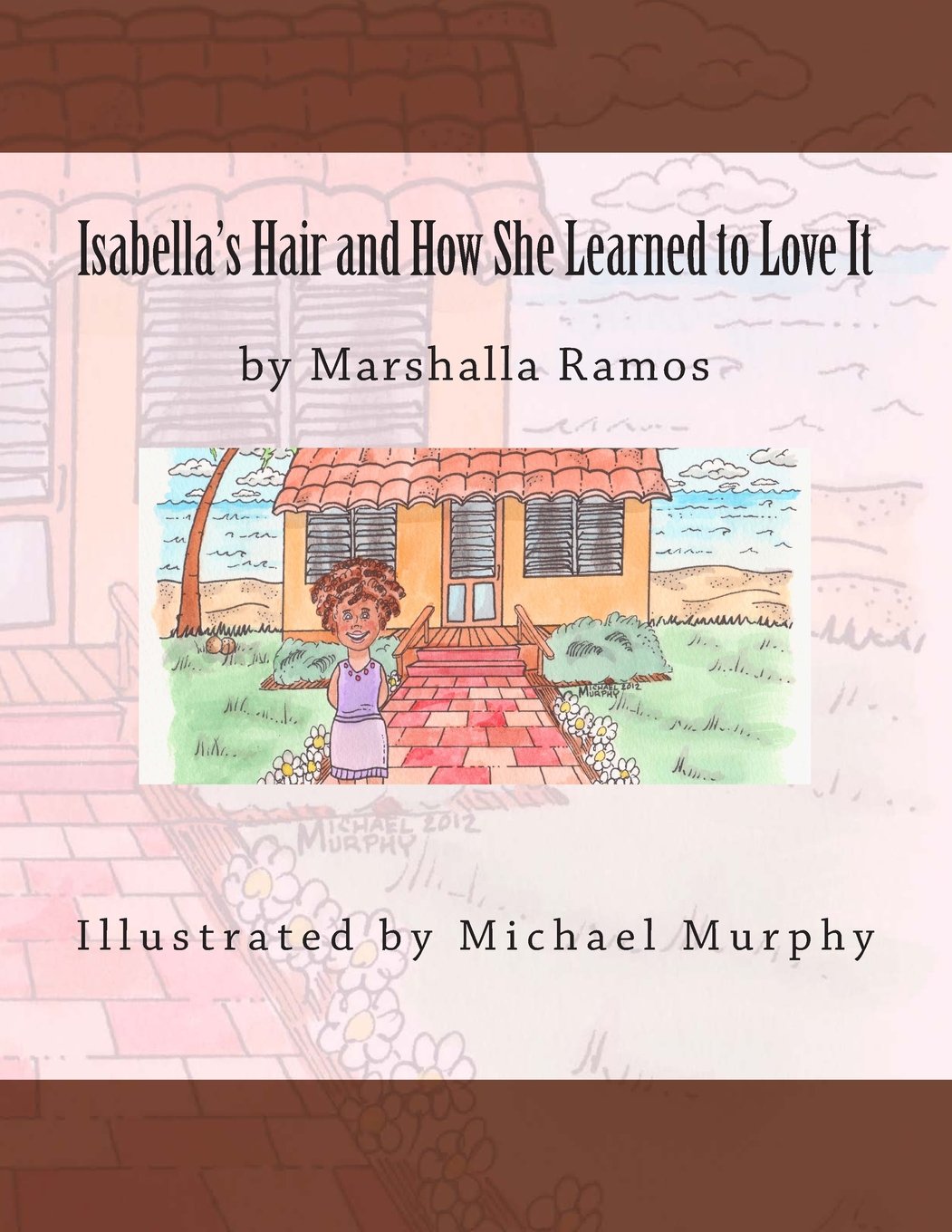
Her debut book, tells the story of Isabella, an Afro-Boricuan, who lives in Carolina, Puerto Rico. With loving support from her abuela (grandmother), Isabella learns self-love and self-acceptance.

isabellashairbookWhy did you decide to write this book? Skin color and hair texture constantly come up in the classroom. As an educator it was important to create a narrative from a child’s perspective. The voice of the protagonist (Isabella) was more than that of a child speaking. It included the expressions of a female who is of Afro-Latino heritage. During the editing process, a lot of memories resurfaced. Through family stories, I had the impression that my grandmothers, both with dark complexions, were strongly persuaded to marry  to “better the race.”  This book is my attempt to offer a debt of gratitude to my grandmothers and to honor the lives they lived.

Do you consider the book autobiographical or semi autobiographical? I think every book a writer writes is based on something they’ve experienced.

Describe the main character Isabella? She’s a beautiful 7-year-old growing up in Carolina. She likes to color each day and draws her family, and wonders why she looks a certain way. She enjoys the view of her yard and playing. People in the community say (negative) things about her color and hair.

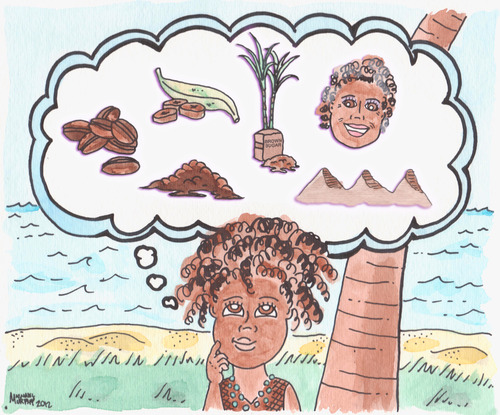
What role does Isabella’s grandmother play in the story? Abuelita comes to visit one day and overhears how Isabella is upset that her mother made her a brown dress that matches her hair and skin. She’s sitting under the coconut tree and wondering why everyone thinks brown is beautiful. Abuelita asks Isabella questions about the things in Puerto Rico that are brown like cocoa beans, soil etc and what they do. These natural things enrich us and so does Isabella’s presence.

Isabellas Hair

An illustration by Michael Murphy from Isabella’s Hair.

What messages did you learn about your hair growing up? In my immediate family, my mom embraced me and taught me I was beautiful. But, my sister has typical Puerto Rican/ Spanish hair, and comments were made by other relatives that I wasn’t as beautiful, or Nuyorican as my sister. I would get teased. It was painful.

As an adult, do you accept your hair? If so, how did you arrive at that point of acceptance? I have locks now. I love them, I love my hair. Around 2007, I stopped relaxing my hair, and felt it was time to embrace my hair texture and who I was, and embracing the term Afro-Latina. I decided it was necessary to understand my African heritage, not to deny this part of me. I wanted people to see the real me. It’s very empowering to feel your own hair texture. It’s much healthier.

Is it important for children of color, particularly Afro-Latino children, to have books that feature Afro-Latino children? If so, why? I belong to the Society of Children’s Book Writers and Illustrators (SCBWI). Every month, a magazine is published. One article was about protagonists in children’s books. Less than one percent represent children of color. Even when I was teaching kindergarten and you asked Scholastic (world’s largest publisher and distributor of children’s books), they don’t have these books. If you look at a child of color, they need to see characters that represent a similar experience to them. Children pick up books that interest them or they can relate to. If they don’t find them, they don’t gravitate to literature as much. Why not have books like this available? It’s important – not just for numbers, but for children’s self-esteem.

What kind of response/reaction are you receiving from the book? I’ve participated in a couple of book fairs and was at La Casa Azul (New York City Bookstore) for Book Day.  My book always sells out and people love it. It was picked up by BarnesandNoble.com. People enjoy the story, and wish they had it when they were young. A young lady bought my book for a friend who adopted a black baby. The book is especially valuable for adopted children and girls.

What projects are you working on? A story about an Afro-Latino boy, titled Leon’s Courage. I’m still figuring out the setting, but it will deal with being smart and the implications of being smart in a neighborhood where kids don’t celebrate that. Leon learns to change negatives into positives with the help of his cousin, Isabella.

Marshalla dreams of returning to Puerto Rico to read her book at schools and bookstores throughout the island.

Isabella’s Hair and How She Learned to Love It was published by Create Space and illustrated by Michael Murphy.

Connect with Marshalla on Twitter and the Facebook page for Isabella’s Hair.

Chef David’s Sweet Potato Cornbread

In our recent post Welcome to Gullah Country! we interviewed Chef David Young, owner of Roastfish and Cornbread Restaurant in Hilton Head Island, South Carolina. Graciously, he agreed to share his recipe for sweet potato cornbread, one of the restaurant’s signature dishes. Enjoy!

If you make this wonderful recipe, tell us what you think and  share your photos with us on FacebookTwitter, or by linking to your own blog post in the comments section below.

Sweet Potato Corn bread
It took over a year to perfect this recipe. It is easier for me to make something just from feeling and tasting, rather than harnessing a flavor with words and writing them down, I had to test many different formulations and ingredients to find the perfect union of flavor and spice. After many taste tests, here it is. I wrote it just for you.

Dchefs’ Sweet Potato Corn bread™
I did not want to give you the same old corn bread, I was not satisfied with basic corn bread and I hated it because the flavor did not punch me in the taste buds. I wanted to make something that was unique so I took two traditional ingredients, corn meal and sweet potatoes and created a new taste sensation.

Read more

Welcome to Gullah Country!

by Kim Haas

Los Afro-Latino’s mission is to bring our readers closer to the people, places, events and movements that impact the Afro-Latino Diaspora. Periodically, we will enlarge the tent, sharing stories of the Great African Diaspora, whatever the topic, whatever the issue, whatever the cause to inspire and to enlighten.

Hilton Head – The Island and The Gullahs

Our inaugural post covering the Great African Diaspora took me to South Carolina’s Low Country this past August, a pilgrimage to the heart of Gullah Culture. It was a late summer visit to Hilton Head Island – a 12 mile long and 5 mile wide barrier island along the Atlantic Coast.

The Gullahs trace their ancestry to enslaved Africans, forcibly brought to the eastern Atlantic seacoast from present day Angola and Sierra Leone, West Africa. Spreading across nearly 500 miles, from Cape Fear, North Carolina in the north to Jacksonville, Florida in the south, Gullahs were enslaved along the Atlantic coast. They were highly skilled and knowledgeable farmers with an expertise in rice cultivation. It was these competencies that made them ideal labor to toil the rice, cotton, sugar cane and indigo plantations of the Sea Islands.

Today, the Gullah population is concentrated in the coastal region of South Carolina and Georgia. Geographically, the area represents the quintessential old South with Spanish moss draping from centuries old oak trees, picturesque antebellum plantations and homes. All of this is punctuated with the slow sway of the Islanders’ drawls and warmly exchanged salutations.

The tight knit Gullah population, with four centuries of existence on Hilton Head, lived in a spirit of community—taking care of the group and the individual—promoting and supporting self reliance. The Gullahs are the oldest surviving African based culture in the United States. They are credited with being the first freed Africans owning land, establishing free public schools and founding the first African free village.

A combination of factors including Hilton Head’s physical remoteness, low elevation and a malaria outbreak prompted the majority of Europeans to flee the island for more comfortable living on the mainland. For the Gullahs these isolating conditions strengthened their community and preserved their language, traditions, religion, herbal medicine, music, storytelling and cuisine, safeguarding their cultural bond to Africa, their homeland.

James F. Byrnes Bridge

In 1956, a crucial change took place on the Island when the James F. Byrnes Bridge, a two-lane toll swing bridge opened Hilton Head to automobile traffic. Along with the bridge’s opening came housing development and tourism. Twenty-six years later, 1982, a larger highway construction project was completed. This time it was the opening of a 4 lane highway, bringing increased development and tourism.

Reflecting on the bridge and highway construction’s impact on island living, many Gullahs credit these two transportation projects with the profound emigration of the community from Hilton Head Island. Yet, despite these shifts the Gullah community is committed to preserving its heritage and sharing it through island tours, arts and crafts, quilting, music and the annual Gullah Festival in Beaufort, South Carolina.

 Gullah Chef David Young

And of course, sharing Gullah culture would be incomplete without sampling its cuisine which uses rice as a premiere component, one pot meals and an array of seafood dishes at Low Country restaurants on Hilton Head and the mainland, particularly in Charleston, South Carolina.

Nowadays, any conversation about Hilton Head’s Low Country Gullah cuisine includes talk about native son Chef David Young, who graduated with a culinary degree from Madison Area Technical College, Madison, Wisconsin. His popular restaurant, Chef David’s Roastfish and Cornbread is located on the island’s south end at 70 Marshland Road, specializing in revered rice dishes, seafood and vegetarian (vegan) food. Chef David’s  ancestors have been living on the island for 175 years. Now, nearly two centuries later, Chef David is one of the island’s hottest chefs.  His star is steadily rising.

He began his voyage into gastronomy at age six, guided by his Gullah great-grandmother, Mary Cohen, who prepared food by memory. For David, her repertoire for Gullah cooking was built on aromas, flavors and tastes. While Mary Cohen’s recipes were never written, her great- grandson’s 2008 cookbook, Burnin Down South is a compilation of Low Country recipes featuring savory dishes like red rice,  She Crab Soup and collard greens.

Burnin' Down South

A big part of Gullah cuisine means taking advantage of nature’s bounty and the abundant seafood of the nearby waters. Seafood has played an integral role in island life. Shrimp burgers, made of ground shrimp and seasoned with herbs and spices on wheat bread, are one of the restaurant’s most requested offerings.

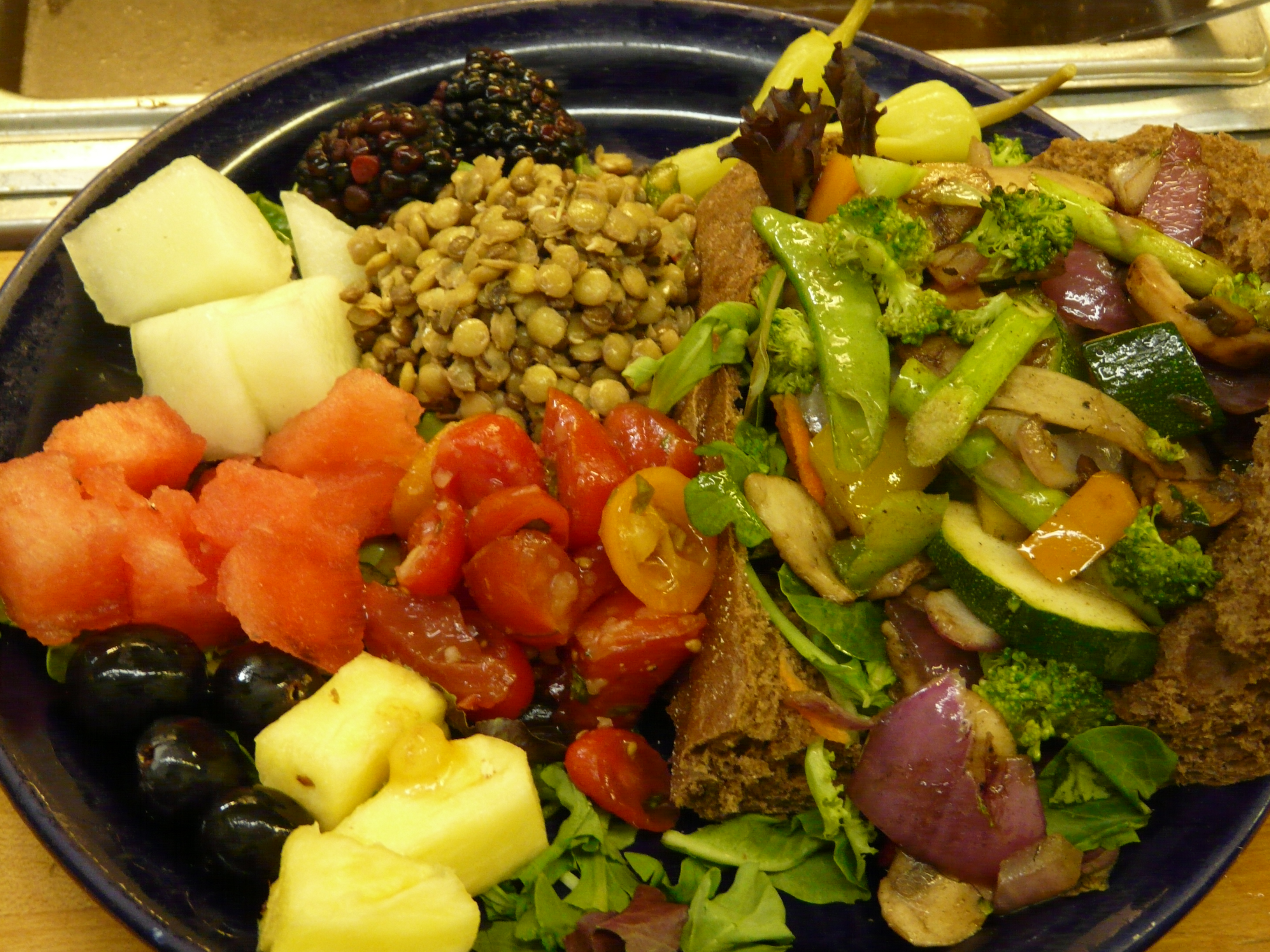
While he’s not a vegetarian, Chef David is building a reputation on the island as one of the few proprietors to include an extensive variety of vegetarian (vegan) dishes on the menu. Chef David’s riff on the quintessential New Orleans Po-Boy, a sandwich filled with roast beef, dripping with gravy on French bread, is a vegetarian delight.  It’s loaded with lentils, sautéed and chopped baby bella mushrooms, onions, peppers, asparagus, broccoli, topped with acai-pomegranate vinaigrette and served on brown bread. The beautifully presented sandwich is complemented with a riotous explosion of colors and flavors including pineapples, berries and watermelon.

Vegetarian Po Boy

Vegetarian Po Boy

Whether vegan, vegetarian, carnivore or locavore, Chef David proudly speaks to the universality of his restaurant, “There is something for everyone here.” Roastfish and Cornbread is dazzling crowds with its steamed chicken, brisket, shrimp burgers and, one of his signature dishes – sweet potato cornbread.

True to his Gullah island upbringing, Chef David is committed to serving fresh, local food. “When I grew up here, everything was organic. People sprinkled potash to keep bugs away.” So, what is Low Country cuisine? According to Chef David, “If you can grow it here and catch it here, it’s Low Country.” The Gullah shrimped, farmed and hunted using the surrounding waters, lands and forests for sustenance. This was the island way of life. “The food is really simple. Anything from chicken, cows, pigs, corn, tomatoes, beans, peas, watermelon, and okra – this came directly from Africa.”

Living with Gullah culinary heritage which is older than the United States is a valuable legacy for Chef David.  “Our Gullah food is older than this country.  We were here before America was a country. It’s the oldest food in this country. We cooked for everybody.” Gullah cuisine is one of the oldest surviving African based cultures in the United States.

With such a strong, powerful culinary past, how does Chef David envision his culinary future? “Keep doing what I’m doing and just keep doing it better. Do it to the best of my abilities, for as long as I can do it.” 

Hispanic Heritage Month: The African Contribution

by Kim Haas

One of my greatest pleasures is the study of Afro-Latino culture. In September, I had a wonderful opportunity to write about the African contribution to Hispanic Heritage for one of the oldest black newspapers in the United States, New York Amsterdam News. The newspaper, which was founded on a $10 investment more than a century ago, has a distinguished history of being at the forefront of covering major issues and events involving people of African descent.

What an honor to share the article with you!

Vicente Guerrero

Vicente Guerrero

Hispanic Heritage Month, Sept. 15 – Oct. 15, offers an opportunity to illuminate what is too often overlooked—the African influence and tradition in Hispanic culture. Today, approximately 150 million Latin Americans have some African ancestry.

For more than 500 years, Africans and their descendents richly contributed to the fabric of Latin American society. During the Middle Passage, an estimated 12 million enslaved Africans were shipped to the Americas. Of this group, less than 10 percent were brought to the United States. The overwhelming majority were transported to the Caribbean and Latin America, where they provided free labor under exceptionally brutal conditions. They worked on cattle ranches in Brazil, in mines in Colombia, on sugar plantations in Ecuador and in other areas throughout the region.

Read more